
Estrid Lutz: Collapse
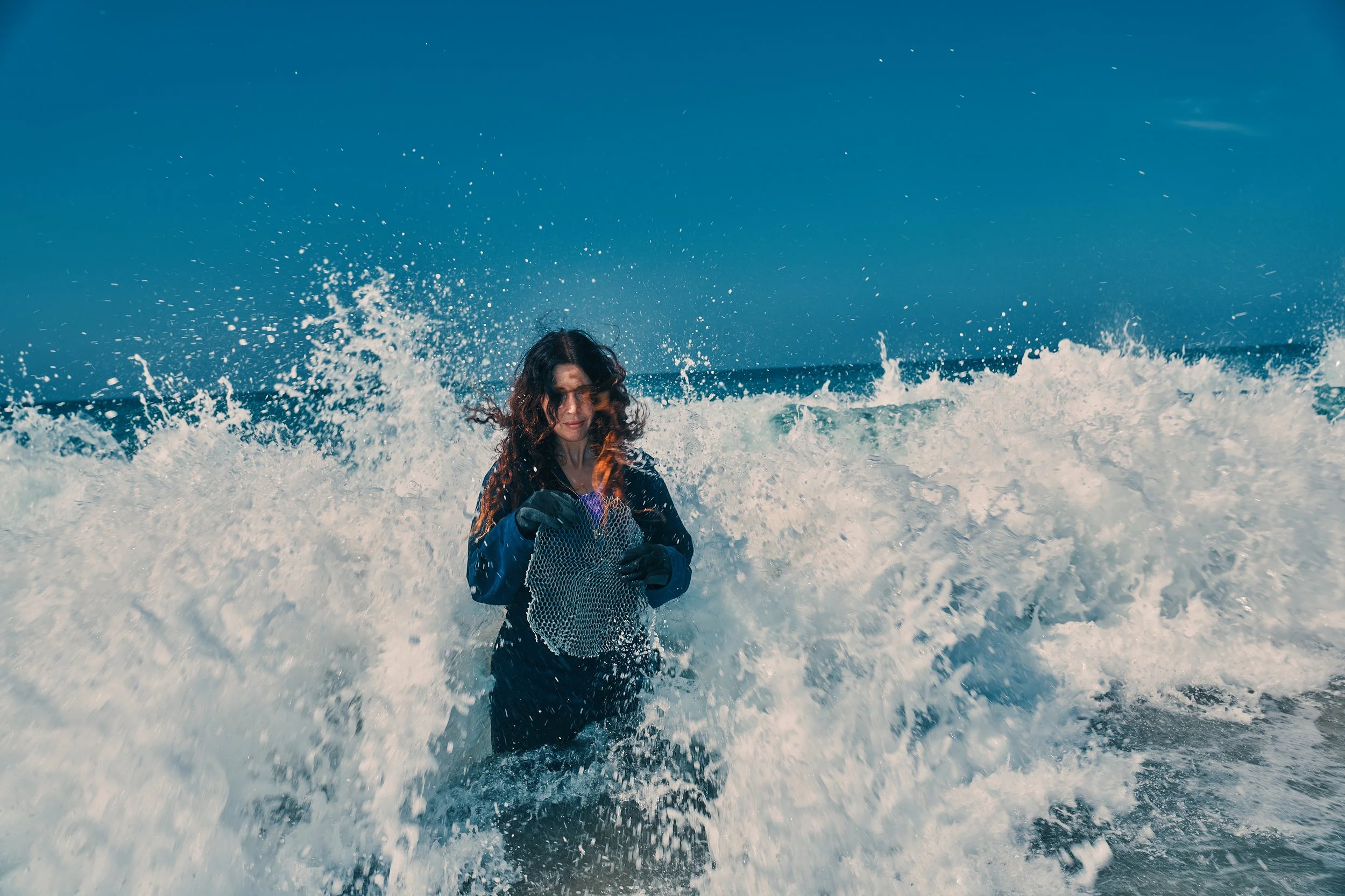
Portrait of Estrid Lutz in Puerto Escondido. Image: Ryan Struck for The Surfer’s Journal.
Estrid Lutz becomes the first artist to collaborate on a limited edition for Art Guides World. We are excited to announce a series of swimwear featuring artworks by Estrid Lutz, ahead of Zona Maco Wednesday, 4 February – Sunday, 8 February 2026 – the principal art fair in Mexico.
Estrid Lutz’ interaction between surf and art can be traced back to at least 2014, during her studies at Art Center College of Design, Los Angeles and Beaux-Arts, Paris when she produced a surfboard printed with an aeroplane turbine, mounted on a rotation engine.
A similar work was exhibited alongside material explorations including early lenticular experiments, three-dimensional collages, and prints on a jelly used to clean keyboards as seen in A Sip of Cool in Marseille. This preceded an exhibition where curators, Charlotte Cosson and Emmanuelle Luciani, extended the theme at MAMO – Centre d’art de la Cité Radieuse which coincided with Lutz’ prestigious residency at Cité Radieuse Le Corbusier in Marseille in 2015.
The flatness of images seen surfing the early internet – now replaced by significantly less explorative and discursive scrolling – continues to drive a fascination with curious materiality that Lutz pioneered over a decade ago.
Collisions between technology and nature have been an enduring theme for Lutz, and surfing is an interesting parallel: toxic resins used to waterproof polystyrene inners become a lifeline for bodies braving ocean waves.
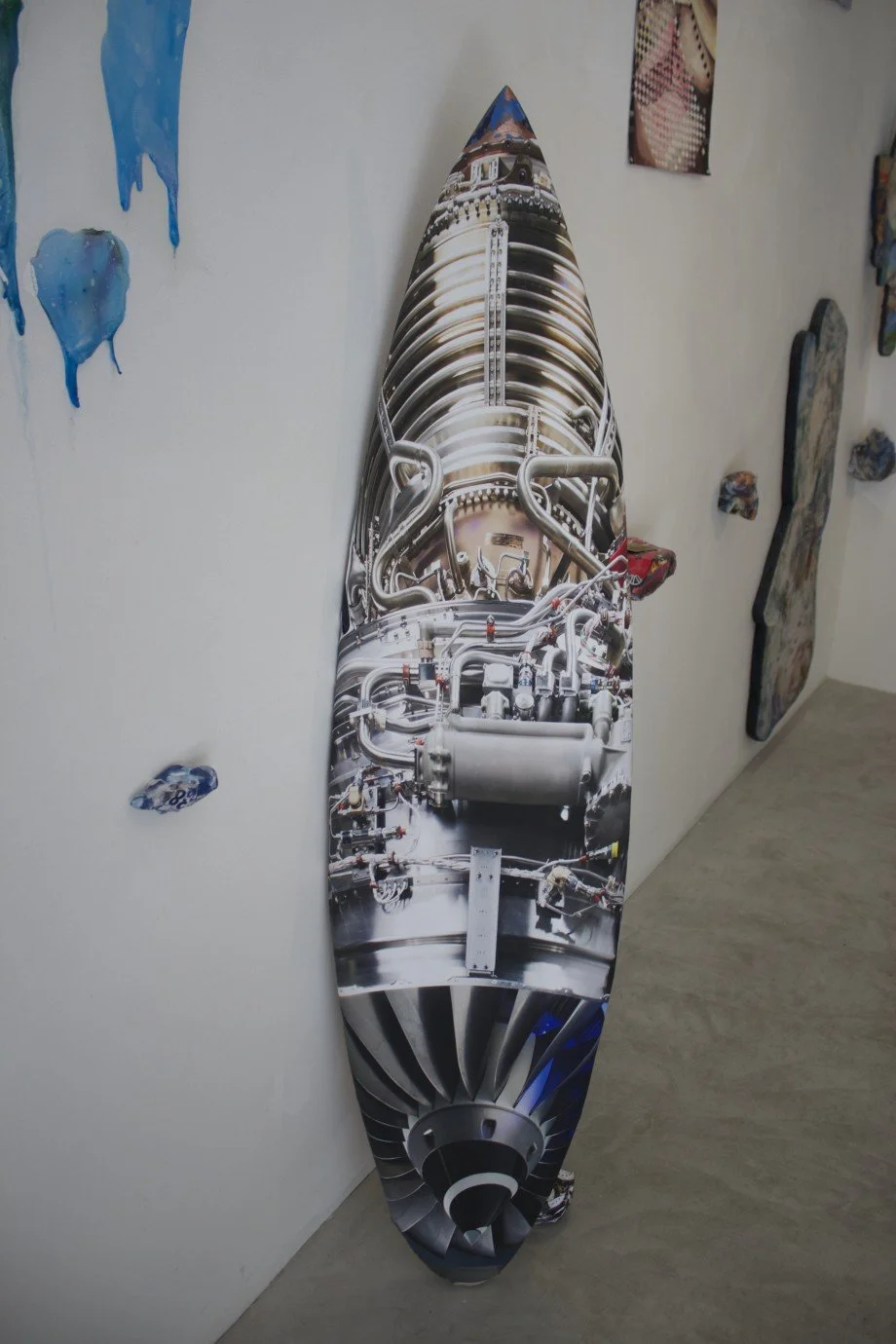
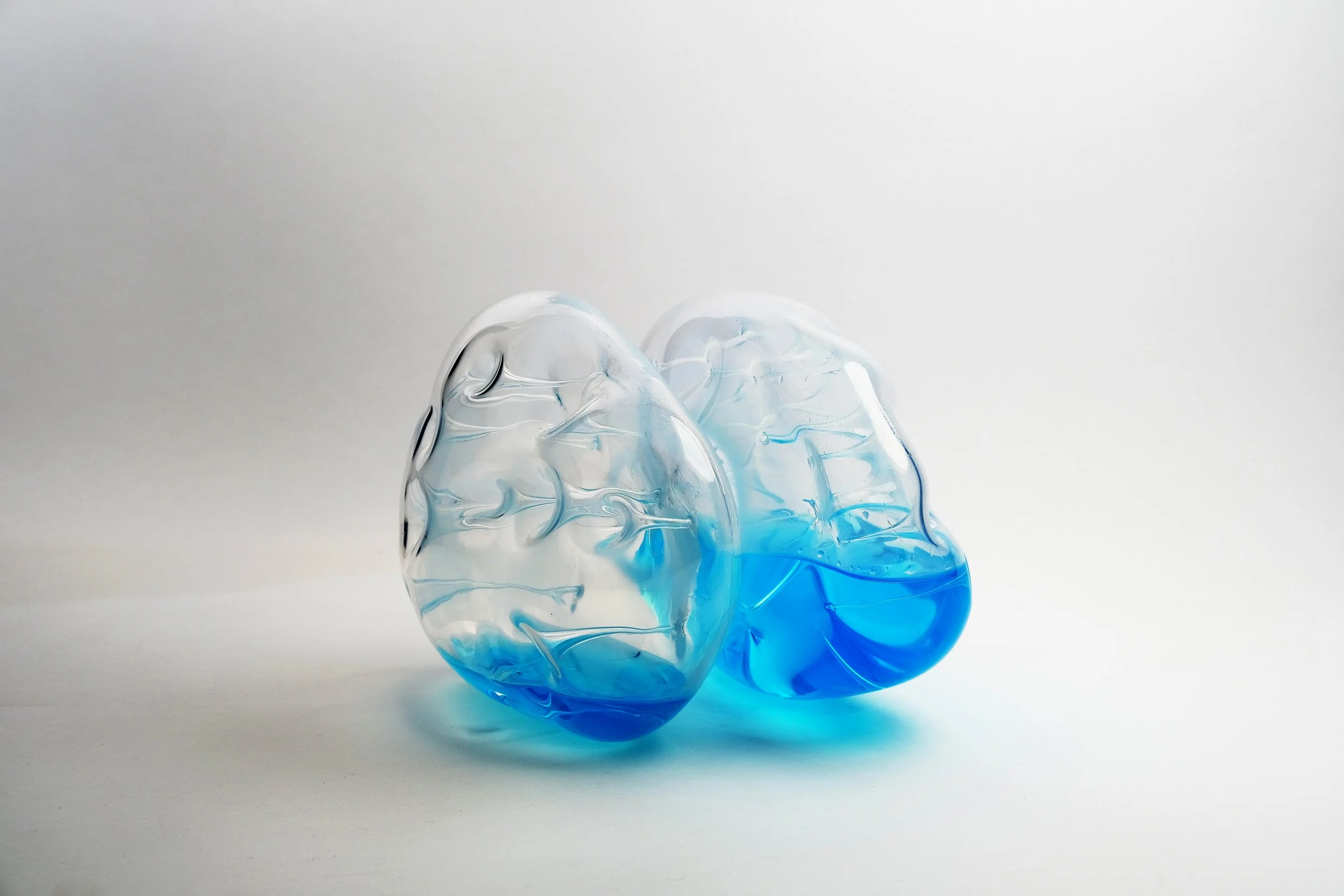
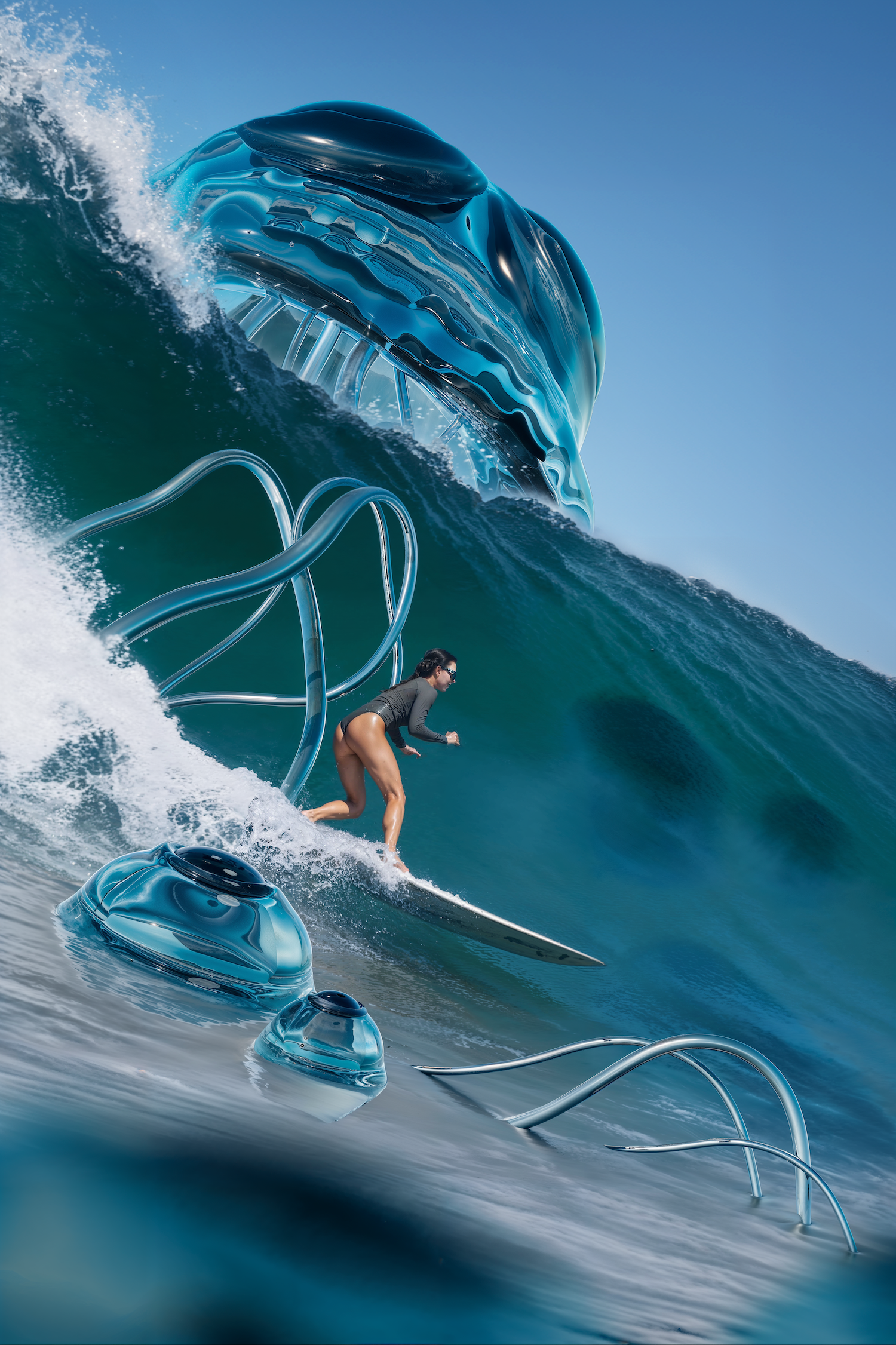
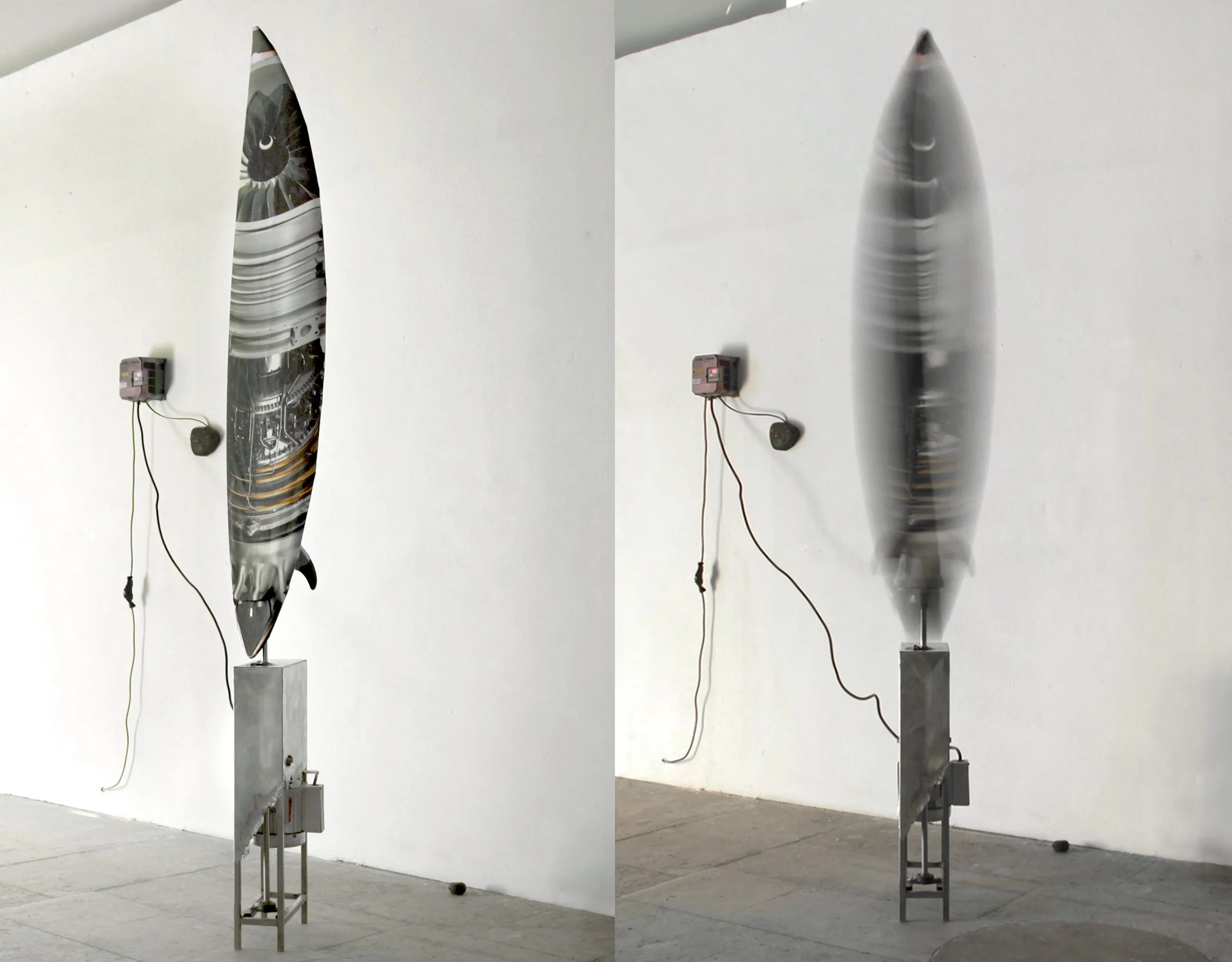
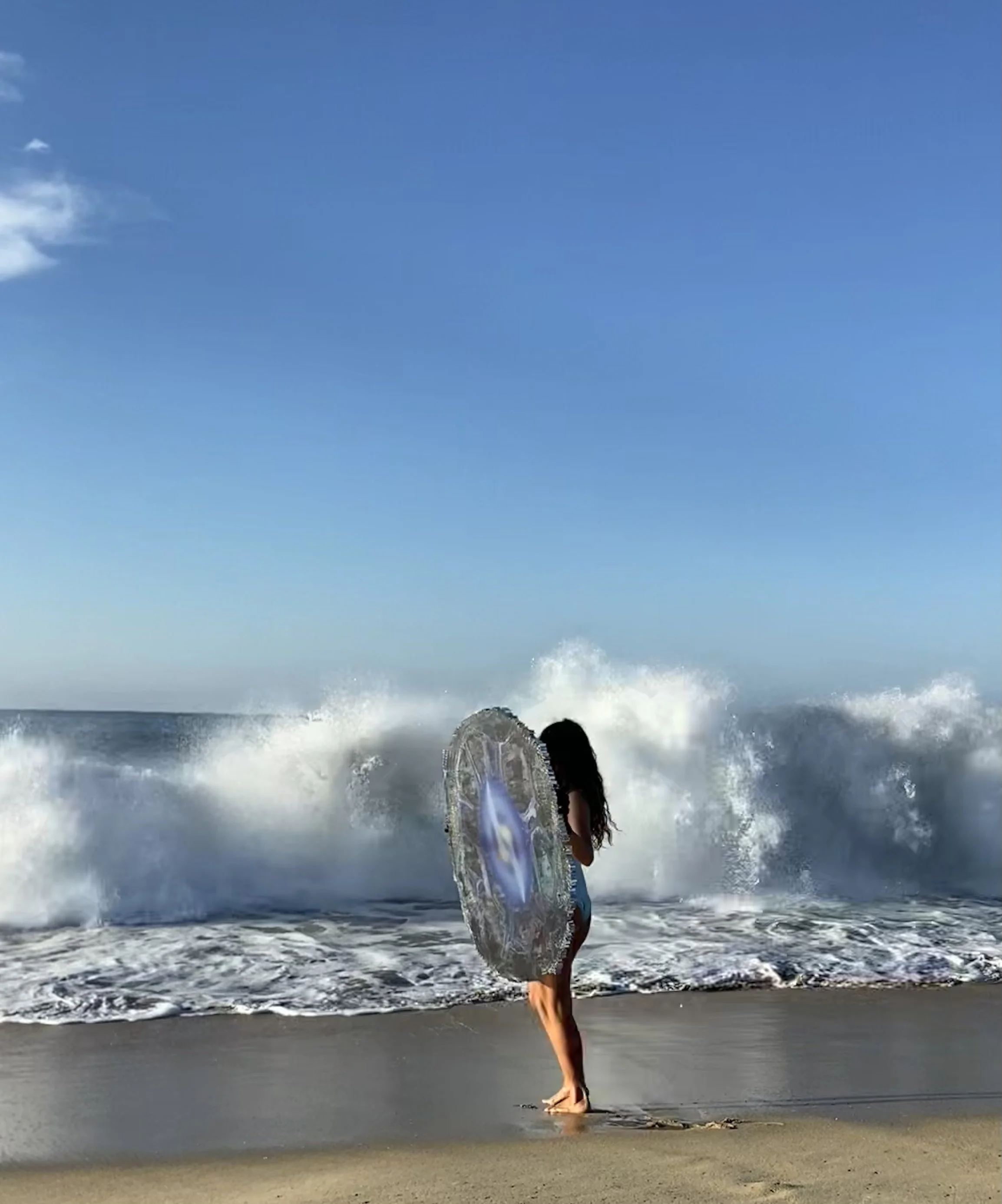
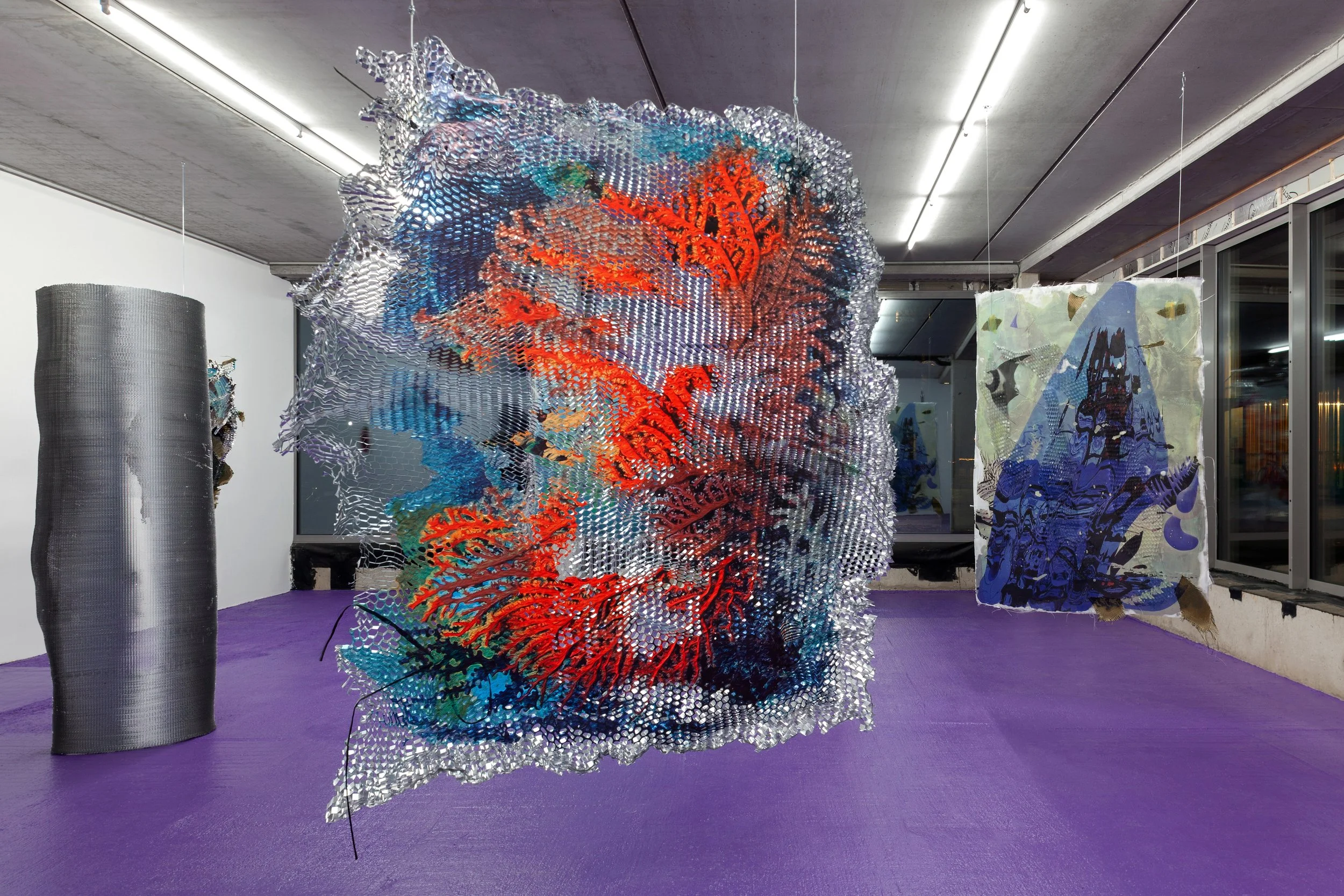
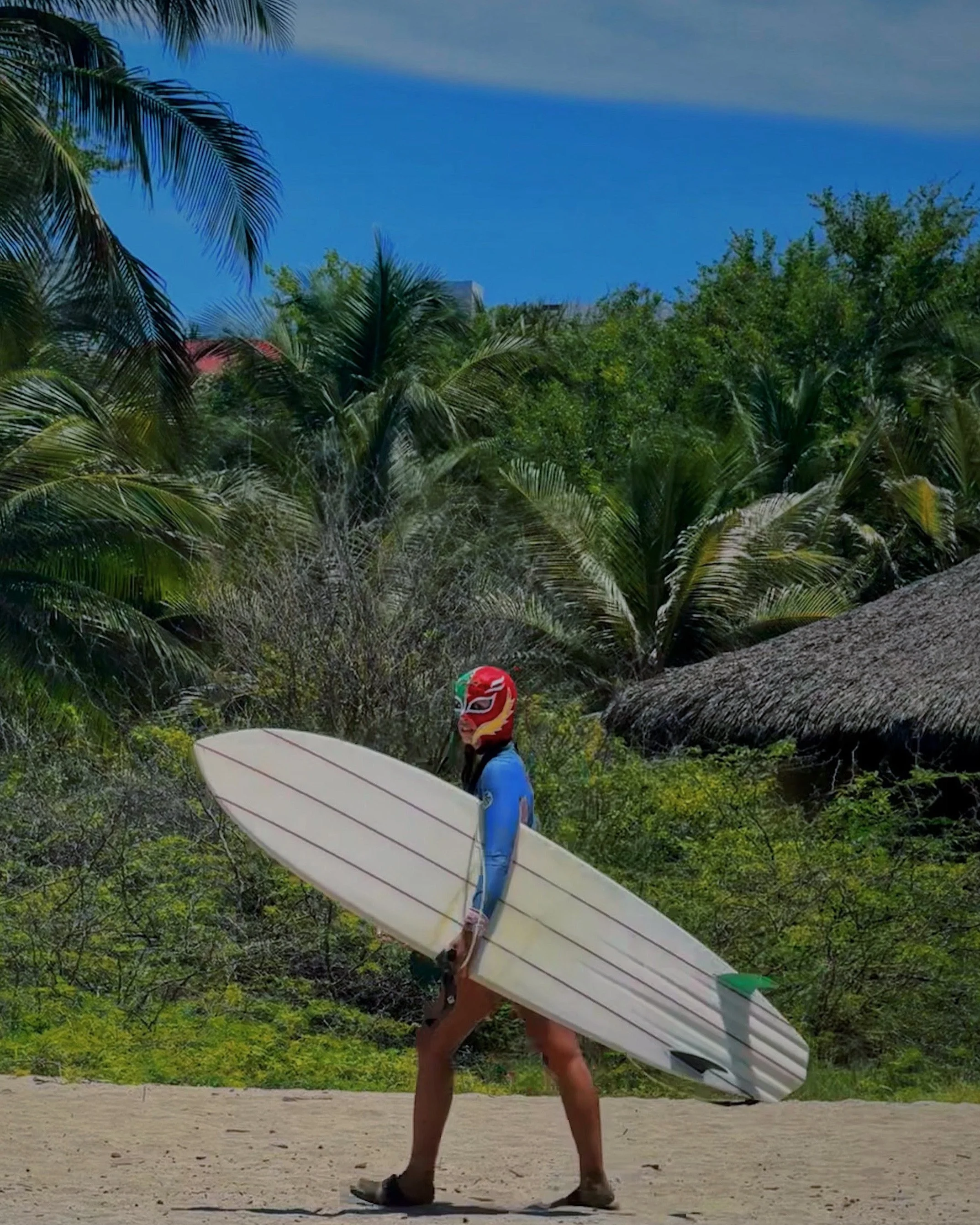
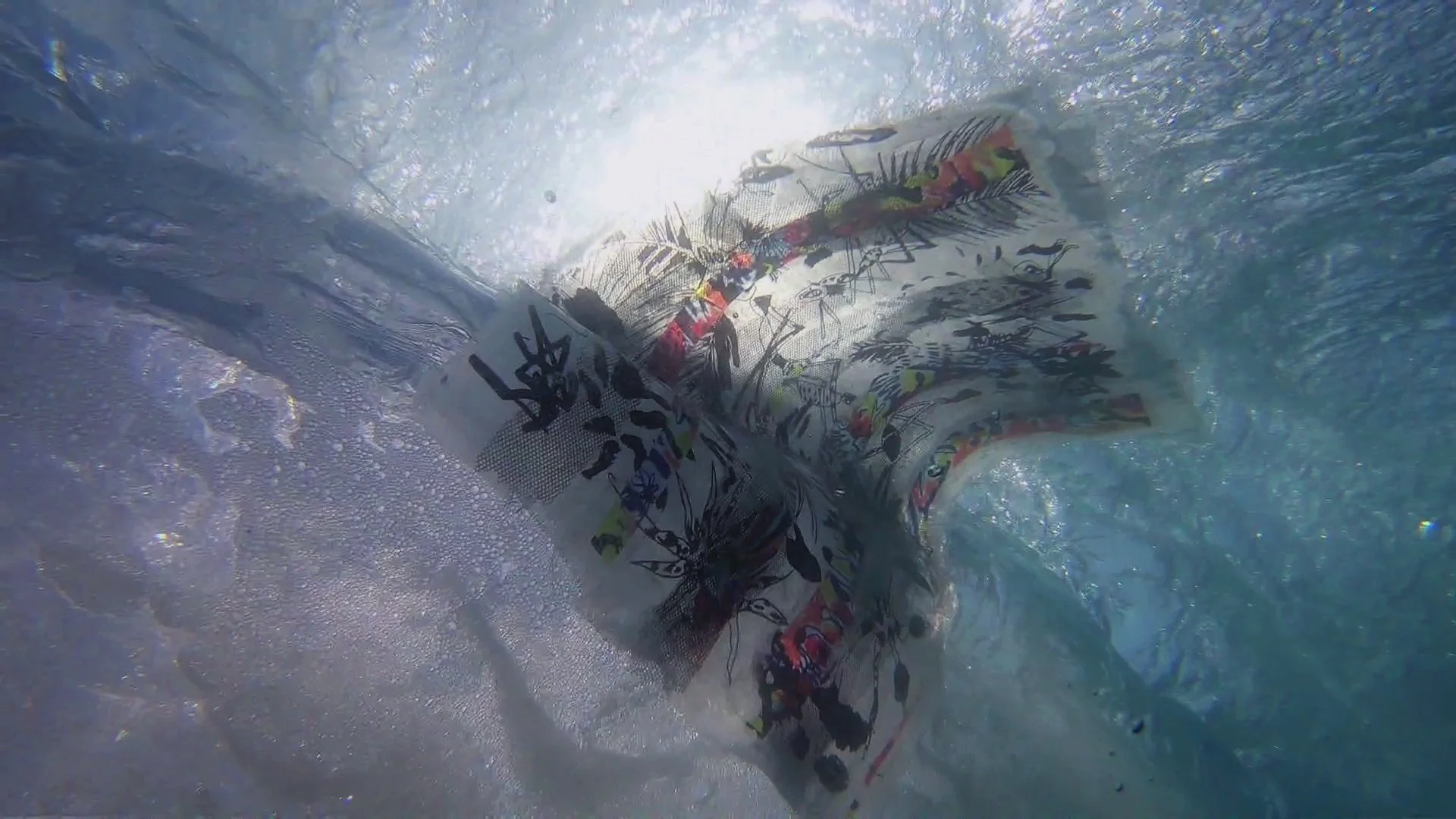
Image credits: (1) Estrid Lutz’ work in A Sip of Cool, La Gad, Marseille 2014; (2) Chaos Sensible Ocean Lungs, Blown glass, ink, water, 2024 ©️ Estrid Lutz ; photo ©️ Cirva / Bérangère Huguet; (3) Estrid Lutz surfing Punta Zicatela. Image David Broner and Pa.Rifarte; (4) COOL / As a State of Mind at MAMO, 2015; (5) Estrid Lutz in Oaxaca; (6) Pipelines Mashups at Everyday Gallery, Antwerp, 2021; (7) Estrid Lutz Surf Lucha Libre in Puerto Escondido; (8) Mosquitoes disappears in ground swells. All images courtesy Estrid Lutz.
Since graduating with honours in 2016, Lutz has exhibited across Europe, China, the U.S. and Mexico, where her works explore conflicting materials and subject matter ranging from datacenters, the rubble of war, Kevlar, fibreglass, carbon fibres, and natural phenomena, including reptilian and sea life.
In 2018 Lutz was included in Crash Test, an exhibition curated by Nicolas Bourriaud at La Panacée, Montpellier Contemporain with a focus on art after the Anthropocene and the inherent molecular human and non-human interrelations. Bourriaud then recommended Lutz to a residency at Casa Wabi, a renowned Tadao Ando designed art foundation on the Pacific coast, a 30-minute drive from Puerto Escondido, Mexico.
It was in Puerto where Lutz’ connection to the ocean developed in her frictional artistic forms, where for example underwater creatures that are most commonly seen on-screen, are transposed onto large lenticular prints, fixed with epoxy resin to honeycomb aluminium used for constructing satellites. She was invited back to La Panacée by Bourriaud in 2019 for a solo exhibition where her “techno-DIY” works emphasised “invisible life forms that make up the Pacific Ocean” including via drawings made with hydrochromic ink that changes colour when wet.
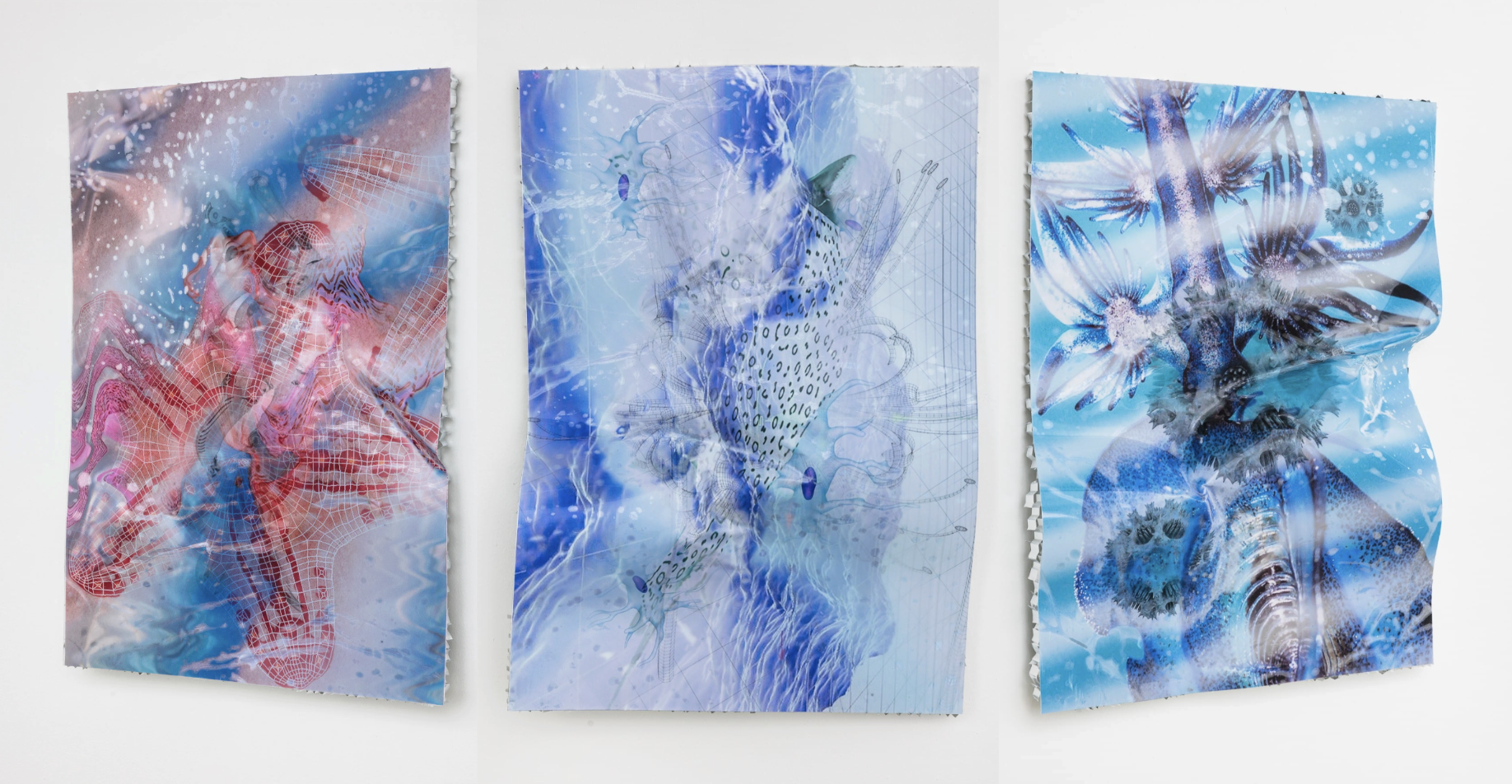
Collapse 0000005, 0000001, and 0000003. Each of the original works are composed of inkjet prints on photographic paper, UV treated, air injected lenticular sheets, anti-corrosion, high temperature resistant honeycomb aluminium, epoxy-resin, and fiberglass.
For the launch we are excited to discuss the three works Collapse 0000001, 0000003, and 0000005 – all made in Mexico, 2023 – which were used in the compositions of the limited edition print-on-swimwear collaborations for Art Guides World.
☉ What subjects can we see abstracted in these artworks?
Collapse series are visual residues of a sculptural collision between biological vulnerability and robotic precision. The viewer navigates a marine bio-verse where the skeletons of starfish, corals, and anemones dissolve into a techno-organic synthesis, captured through air-bubble injections and chemical manipulations.
Amidst the fluid textures of human skin and microscopic life like plankton, the spectral silhouette of two robots kissing emerges, interlaced over the industrial grid of the spacecraft material support. This layering creates a speculative landscape where the invisible becomes armor, transforming the surfaces into an extension of both satellite rigidity and oceanic fluidity. A sort of marine techno interface.
☉ Can you explain what collapse means to you?
Collapse defines an ontological framework rather than mere destruction; it is the state of a planet where boundaries between species, humans, and machines have dissolved into a singular techno-natural system. This concept explores zones of critical friction—from spacecraft debris to the molecular upheavals triggered by ecological crises and warfare.
In my process, "Collapse" functions as a method of assembly by collision, where disparate materials—Kevlar, resin, and photographic paper—are forced to cohabitate to imagine hybrid habitats born from the friction of co-existence.
☉ How has Mexico inspired your work?
Proximity to the Zapotec and Mixtec traditions of Oaxaca offers a perspective on communities living in direct dialogue with the raw forces of nature.
My practice has been developed over the last eight years close to Zicatela: the Mexican Pipeline. The mechanic and esthétique of this wave is my primary inspiration; it is a real monumental baroque sculpture herself.
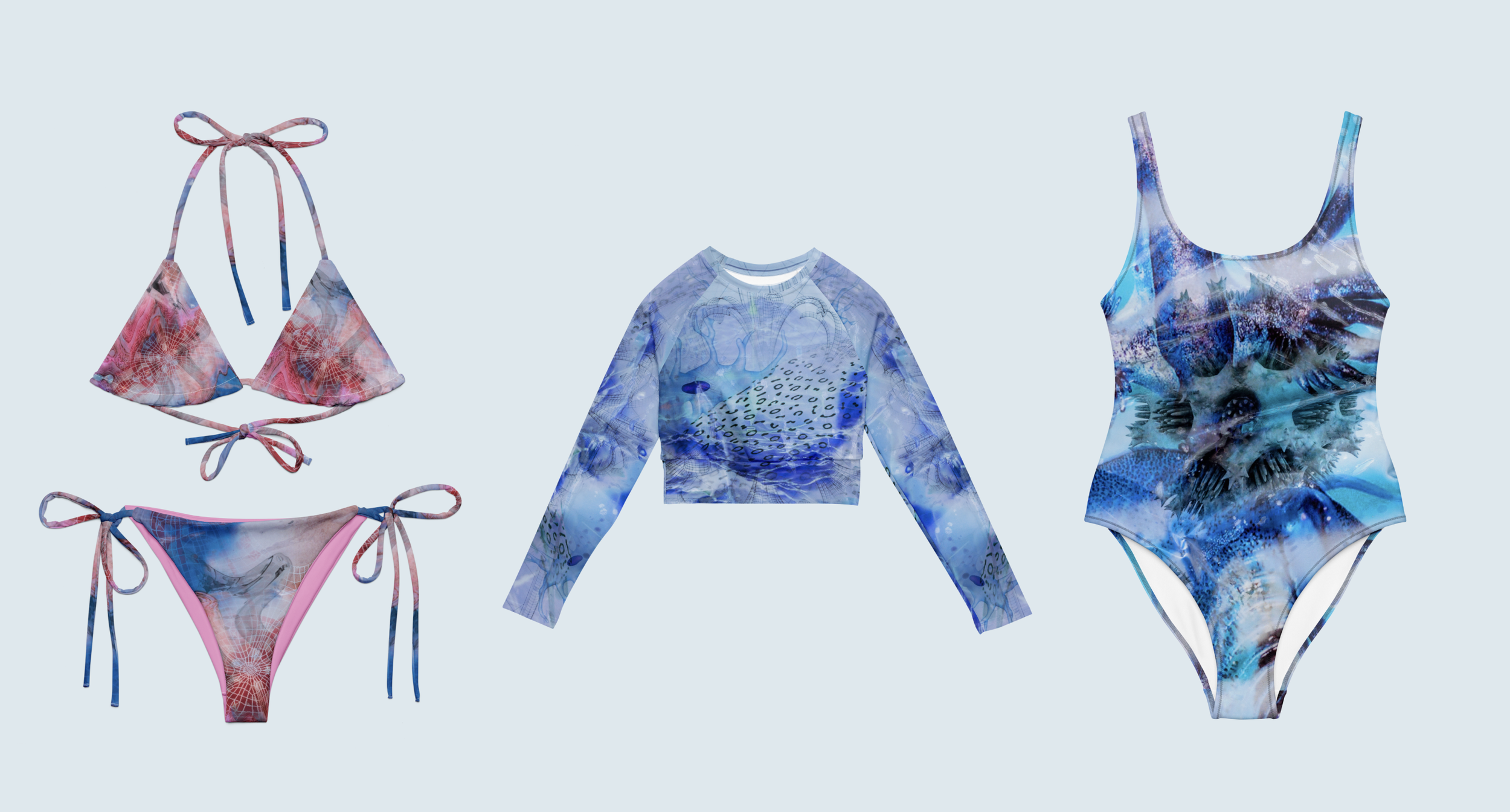
Recycled materials comprise the majority of the swimwear which are printed-on-demand to reduce waste.
